
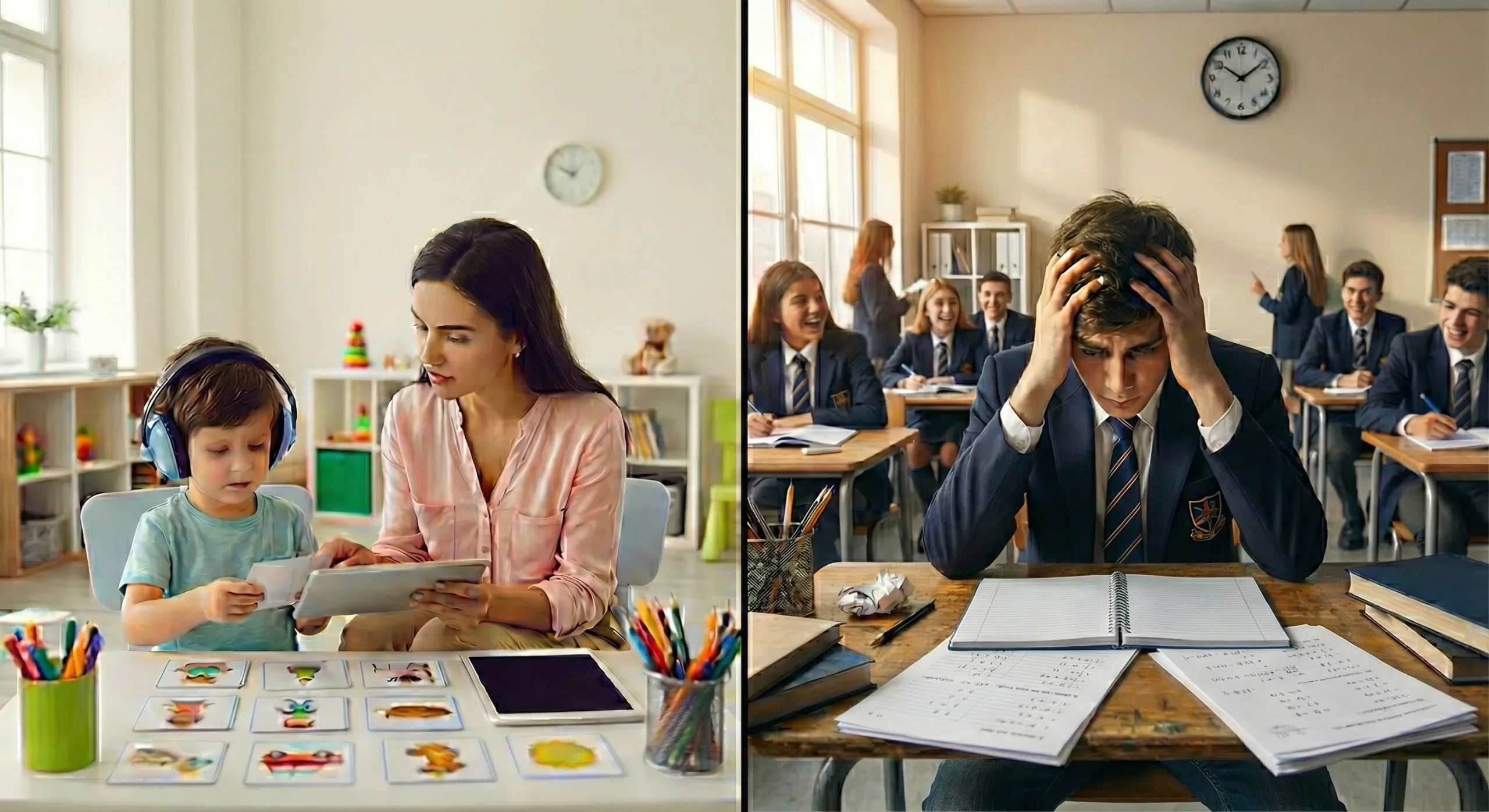
We often hear the phrase ‘wait and see’ in relation to child development. In the context of autism, particularly for those children who do not fit the stereotypical profile, this phrase is not just unhelpful; it is dangerous. It implies that distress is a phase, that sensory overwhelm is a behavioural choice, and that the child will simply ‘grow out of it.’
They do not grow out of it. They grow into a world that repeatedly tells them they are broken.
The core argument I have made throughout my career is simple, yet seemingly radical, in a system paralysed by bureaucracy: misdiagnosis is not merely a clinical error; it is a profound systemic failure with potentially devastating consequences. When we miss the autism, we miss the child. We leave them to navigate a sensory and social minefield without a map.
To understand the life-altering power of a timely diagnosis – a true ‘stitch in time’ – we must look at two diverging paths. These are not hypothetical case studies; they are amalgams of the lived experiences of the many families I have worked with.
The ‘stitch in time’ – Leo
Leo was seven when he came for an autism assessment. At primary school, his teachers noticed that he didn’t just ‘dislike’ noise; he was physically pained by it. He struggled to transition from the carpet to the desk. He often failed to finish work he wasn’t interested in and had a tendency to wander round the classroom during lessons. He was passionate about trains, to the exclusion of the playground games his peers enjoyed.
In a ‘wait and see’ world, Leo may have been labelled ‘difficult’ or ‘distracted.’ He would have be forced to sit still, forced to make eye contact, and punished for the meltdowns that inevitably occurred when his nervous system was pushed past its limit.
But Leo’s parents and school took a different approach. They sought an early assessment. They didn’t view a diagnosis as a label to be feared, but as a passport to understanding.
Because Leo was identified as autistic at seven, the narrative around him changed immediately. He wasn’t ‘naughty’ for covering his ears; he was experiencing sensory processing difficulties. The school implemented reasonable adjustments immediately. Leo was given ear defenders for assembly. He was allowed a visual timetable so the anxiety of the ‘unknown’ didn’t consume his working memory.
Crucially, Leo was told he was autistic. He was given the language to understand himself. He learned that his brain worked differently, not wrongly.
Fast forward to Leo at eighteen. He is thriving. Yes, he still finds social nuances exhausting, and yes, the sensory world is still loud. But he is not in crisis. He has not internalised a sense of failure. He advocates for himself, explaining to teachers, ‘I need a movement break,’ rather than flipping a desk in frustration. This is the ‘stitch in time.’ By addressing the need early, we prevented tearing the fabric of his mental health. He flourishes not because he is ‘cured’ of autism, but because he is supported in it.
The tragedy of the missed – Mia
Mia is the same age as Leo. At seven, she was the model pupil. She was quiet, compliant, and excessively polite. Her teacher described her as a ‘pleasure to have in class.’
But looking closer, with a clinician’s eye, the signs were there. Mia didn’t play with other children; she played alongside them – she observed them, mimicking their behaviour to survive. She made eye contact, but it was forced and intense. At school, she held it together. At home, the ‘coke bottle effect’ took over – the pressure that had built up all day exploded in violent meltdowns, screaming, and exhaustion.
When her parents raised concerns, they were dismissed. ‘She’s fine at school,’ they were told. ‘It must be a parenting issue’ and ‘Mum is too anxious’.
Mia learned a dangerous lesson – her struggle was invisible, and her pain was invalid.
The transition to secondary school is often the cliff edge for these unidentified children. The environment became larger, louder, and less predictable. The social rules became so much more complex. Mia, terrified of getting it wrong, masked harder. She smiled until her face ached. She suppressed the ‘stims’ that helped her to regulate, until her body vibrated with anxiety. School work became much more complex. The bright, intelligent girl who had done so well at primary school, suddenly found that the work was too abstract – she could never quite work out what the teacher wanted when homework was set.
By thirteen, the mask began to slip. She couldn’t attend school. The sensory assault of the corridor was akin to physical pain, she was being bullied and teased by her peers. The school, seeing only the behaviour and not the cause, labelled this ‘truancy’ and ‘school refusal.’ They threatened fines. They threatened prosecution.
Mia, internalising this failure, began to attack her own body. If she couldn’t control her environment, she would control her pain. Self-harm became her release.
The slide into the system
Here, the tragedy compounds. Because Mia didn’t present with stereotypical features of autism, because she could hold a conversation and had high empathy, she was not assessed for neurodivergence. Instead, her distress, her emotional volatility, and her self-harm were viewed through a lens of personality pathology.
She was diagnosed with ‘Emerging Borderline Personality Disorder’ (BPD).
I have stated this before, and I will state it again with the utmost conviction, personality disorder should never be diagnosed in teenagers. It is a label that carries immense stigma and suggests the problem lies within the individual’s character, rather than their environment or their neurobiology.
In the unit, Mia’s autistic meltdowns were viewed as ‘attention-seeking’ or ‘non-compliant.’ She was restrained. She was secluded. She was detained in an inappropriate setting that stripped her of her dignity and exacerbated her trauma.
Mia is now eighteen. Her life expectancy is statistically curtailed. She has spent her formative years medicated, restrained, and misunderstood. She believes she is broken. She believes she is ‘bad.’
This was not inevitable. This is an avoidable tragedy.
Seeing behind the mask
Mia’s story illustrates the concept of ‘diagnostic overshadowing’. Her anxiety and self-harm were so loud that the clinicians stopped looking for the cause. They treated the smoke and ignored the fire. They saw a ‘difficult’ teenage girl, not a terrified autistic human being desperately trying to communicate her distress.
We are currently facing a crisis in mental health care for young people. We see a proliferation of acronyms – ODD (Oppositional Defiant Disorder), BPD, applied to children who are simply misunderstood. We ask, ‘What is wrong with this child?’ when we should be asking, ‘What has happened to this child, and what does this behaviour tell us about their experience of the world?’.
The moral imperative
It matters because the cost of missed diagnosis is measured in human lives. It matters because we are detaining autistic people in hospitals, miles from their families, traumatising them in the name of ‘treatment.’
We need a fundamental shift in how we approach assessment. We need clinicians who are not just ticking boxes on a DSM-5 checklist – a manual that is often shortsighted and overlooks the way able autistic girls mask their difficulties. We need professionals who possess the ‘clinical nose’ to spot the subtle cases – the girl who makes eye contact but has no peer group; the boy who is ‘fine’ at school but destroys his bedroom at 4 PM.
We need to move away from relying solely on the rigid, ‘gold standard’ assessments like the ADOS which often fail to capture the nuance of the camouflaged autistic experience. If the map (the test) does not match the territory (the child), the map is wrong. On this point, I must add that I have other, serious, concerns. The demand for autism assessments across the country has led to a huge rise in the number of clinicians being trained to use the ADOS and carry out assessments. Some of these clinicians are excellent and bring huge amounts of experience to the role. Others are sadly less proficient and are forced, by this lack of experience, to use the ADOS as a strict ‘tick box’ criteria to determine whether or not someone receives a diagnosis. There is often no way of knowing when you book an assessment, either privately, or through the Right to Choose route, which category the clinicians assessing your child fall into.
At Help for Psychology, we pride ourselves on providing a mentoring service for all new clinicians that join us. If they are relatively new to assessment, we sit in on their early assessments and provide them with supervision and feedback – sharing the knowledge we have gained over many years with them.
Conclusion
We must stop waiting for children to fall apart before we offer them support. We must challenge the professional detachment that allows clinicians to label distress as ‘personality disorder’ rather than investigating the neurodevelopmental reality.
To the parents fighting for an assessment: trust your instincts. You are the experts on your children. To the clinicians reading this: I urge you to look closer. Ask yourself – could this person be autistic? Could their ‘defiance’ be anxiety? Could their ‘drama’ be sensory pain?
Asking that question—and acting on it sooner rather than later- could quite literally save a life.
Unlock clarity and access our Free Screening to see if your child shows signs of possible Autism.
Unlock clarity and access our Free Screening to see if your child shows signs of possible Autism.
Related Posts

Online assessments – 17 months on
In March 2020, when the first lockdown to try and manage the spread of the...

Noah’s journey
The story of Noah really highlights how, with the right support, autistic young...
Transitioning to secondary school from primary school for Autistic children
Article Updated - September 2022Many children (especially girls) do not receive a...

Autism related training videos for GPs and other health professionals
Help for Psychology, an organisation with extensive experience in supporting...