
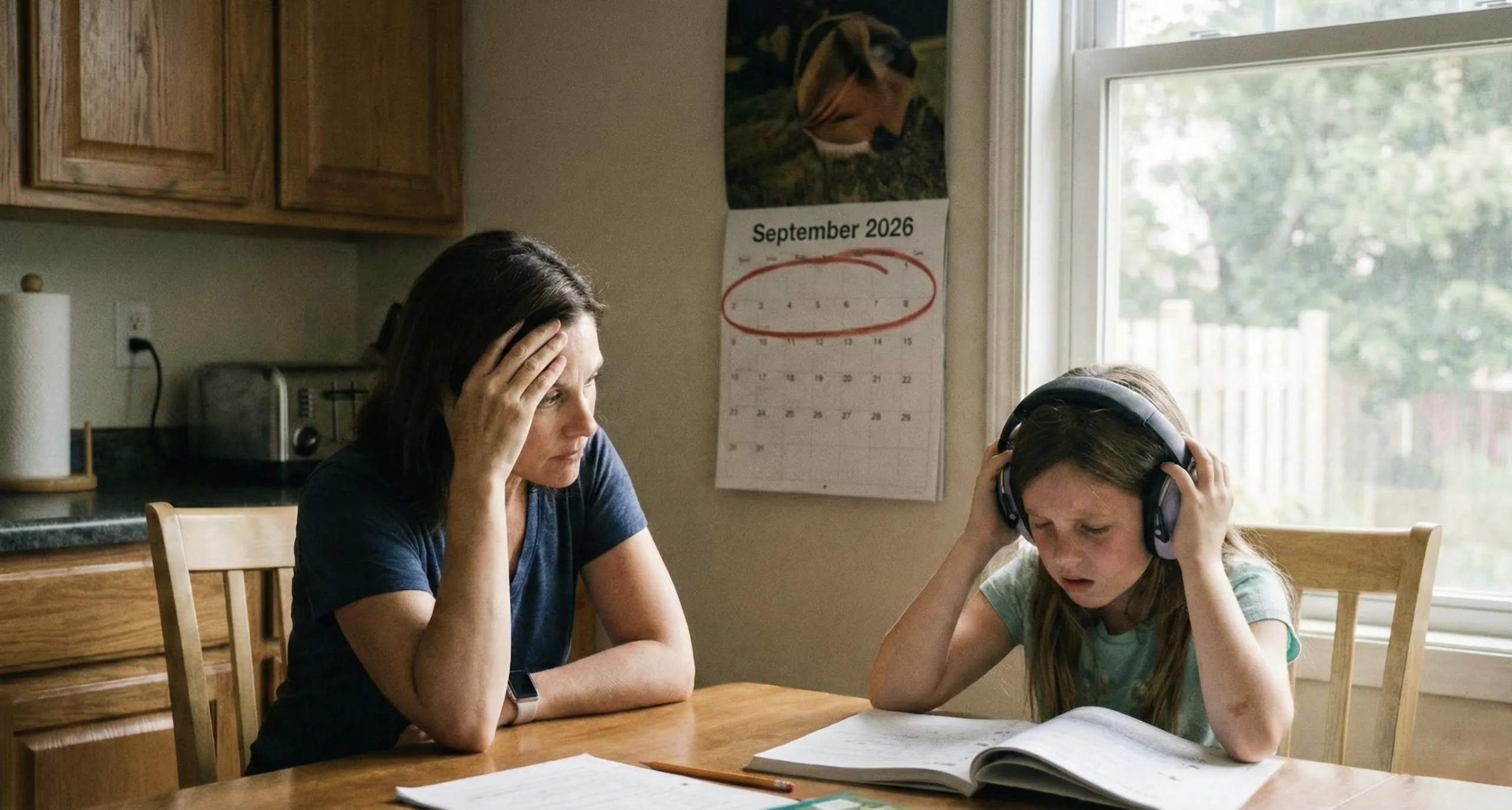
But I am here to tell you something that might feel uncomfortable, perhaps even alarmist. Because I see the human cost of delay in my clinic every single day, I have a moral obligation to say it.
If you have a child in year six and suspect they may be autistic, and you want them to thrive in secondary school in September 2026, the time to act is not next year. The time is now.
We are facing a perfect storm in the UK’s education and health systems. It is a storm where the innocent – our ‘good,’ quiet, masking children (particularly girls), are the ones most likely to be swept away.
The great deception of primary school
Autistic children, particularly girls, are masters of survival in this environment. They employ what we call ‘social camouflaging.’ They find a ‘safe’ friend to shadow. They become the teacher’s helper – the ‘little mother’ who organises the book corner – because organising objects is safer than navigating the chaos of the playground.
Because they are not flipping tables or throwing chairs, they are labelled ‘fine.’
But this ‘fineness’ is a house of cards.
The cliff edge of secondary school
Imagine this: Instead of one room, your child must navigate twelve. They have to move through crowded, deafening corridors every fifty minutes, jostled by hundreds of larger bodies. The smells of the canteen, the strip lighting in the science lab, the echo in the Sports Hall, all are a sensory assault.
Instead of one teacher who understands their ‘quirks’, they have ten teachers. Ten different sets of expectations. Ten different interpretations of whether their lack of eye contact is ‘shyness’ or ‘insolence.’ They have to remember a timetable, a locker code, and which book to bring for Period 3.
On top of this, the curriculum becomes more complex, more abstract, less easy to work out exactly what the teacher requires. Homework becomes more demanding, and particularly for girls, friendships become far more complex to negotiate.
For a child who is already using 90% of their cognitive energy just to mask their autism in primary school, secondary school demands 150%. The maths doesn’t work.
Let me tell you about ‘Isla’.
By October of Year 7, Isla wasn’t just struggling. She had collapsed. The sensory overload and the pressure of simply getting through the day, triggered a state of permanent fight-or-flight. She began refusing to get out of bed. When her parents tried to force her, she threatened self-harm. She was excluded for an ‘outburst’ when a teacher shouted at her – an outburst that was actually a panic attack.
Isla spent the next two years out of education.
So, why does this matter?
But you cannot put these life-saving measures in place overnight.
The EHCP marathon
To get the support your child needs for September 2026, you may need an Education, Health and Care Plan (EHCP). An EHCP is supposed to be the ‘Golden Ticket.’ It is a legal document that dictates exactly what support a school must provide. It can also name a specific school – sometimes a specialist setting – if a mainstream environment is unsuitable.
But the EHCP process is broken. Legally, it should take 20 weeks. In reality, with local authorities overwhelmed, it can take a year.
If you want an EHCP in place for the start of Year 7 (Sept 2026), you need to be applying for it now or in the very near future. And to apply for an EHCP, you need evidence. You need professional reports that state, unequivocally, ‘This child is autistic, and here is what they need and exactly why the mainstream environment causes them harm.’
This is where Help for Psychology steps in.
We are not just diagnosticians. We are advocates. When we assess a child, we do not just give you a diagnosis. We provide a comprehensive report that details the functional impact of the condition. We write our reports with the EHCP process in mind. We explain why your child may need a laptop, why they need a quiet space, and why a rigid behaviour policy will traumatise them.
We give you the ammunition you need to fight for their future.
The ‘elephant in the room’: NHS funding and availability
Many of you know that Help for Psychology is an approved provider under the NHS Right to Choose (RTC) scheme. This is a wonderful initiative that allows families to bypass local waiting lists and have an NHS-funded assessment.
However, we must be transparent about the current state of the NHS.
We are currently operating in a climate where demand for autism assessments has exploded, but NHS funding has not kept pace. Integrated Care Boards (ICBs) – the bodies that hold the purse strings – are facing a financial crisis. As a result, they are issuing what are known as ‘Indicative Activity Plans’ (IAPs).
Let me explain what this means in plain English.
An IAP is effectively a cap. The NHS is telling providers like us, ‘We only have the budget for you to see X number of patients this financial year.’
Here is the frustrating, heartbreaking paradox: We have the clinicians. We have a team of brilliant, highly specialised psychologists, speech therapists, occupational therapists and specialist doctors, who are ready to work. We have the capacity to see more children. But because of these Indicative Activity Plans, we are now restricted in how many NHS Right to Choose referrals we can process.
We are currently in a position where referrals from across England are outstripping the funds the NHS has made available to us. This is entirely outside of our control. It is a bureaucratic ceiling that leaves us with empty clinic slots that we are not allowed to fill with NHS patients.
The difficult choice: Why private assessment may be necessary
Because our NHS capacity is capped by these funding limits, we have immediate availability for private assessments.
I know that for many families, finding the money for a private assessment is a significant burden. It is money that should be spent on holidays, or school uniforms, or heating. It feels unfair that you should have to pay for a service that should be free.
And you are right. It is unfair. It is a tragedy of a system under immense strain.
However, I have to ask you to weigh the cost of a private assessment against the cost of waiting.
If you wait for a local NHS assessment, you could be waiting 2–3 years. In some areas, waiting times are as high as seven years. By then, September 2026 will have come and gone. Your child will have transitioned to secondary school without a diagnosis, without an EHCP, and without protection. They will be thrown into the deep end without a life jacket.
By choosing a private assessment with Help for Psychology now, you are buying time.
- Certainty: You will know, within weeks, exactly what your child’s profile is, along with the individual support they may need.
- Evidence: You will have the specialist report you need to apply for an EHCP immediately.
- Positioning: You will be able to choose your child’s secondary school based on reality, not guesswork. You can say to the SENCO, ‘Here is their diagnosis, and here are the reasonable adjustments they are legally entitled to.’
Whether you are able to navigate the Right to Choose pathway (subject to the funding caps) or whether you decide to prioritise a private assessment to guarantee the timeline, the outcome is the same: Validation.
We validate your gut instinct that something is harder for your child than it is for others. We validate their experiences.
Please, do not wait until the crisis hits in Year 7. Do not wait until the school refusal starts.
The transition to secondary school is the biggest hurdle your child will face in their young life. Let’s make sure they have the armour they need before they step onto the battlefield.
Unlock clarity and access our Free Screening to see if your child shows signs of possible Autism.
Unlock clarity and access our Free Screening to see if your child shows signs of possible Autism.
A ‘Gold Standard’ assessment process led by HCPC-registered clinicians. We go beyond diagnosis to provide a clear pathway for your child’s future.
Related Posts
A Threat to Neurodiversity? Unpacking the Children’s Wellbeing and Schools Bill
Neurodiversity advocates raise concerns about the Children's Wellbeing and...

A stitch in time or a lifetime of scars? The urgent case for early autism assessment
Exploring the need for early child autism assessments to prevent a lifetime of...
The Digital Playground: A Kind Guide to Online Safety for Your Neurodivergent Teen
Navigate online safety with your neurodivergent teen. Learn to empower them with...

Autistic Burnout and Misdiagnosis: The Hidden Toll of Masking
For many neurodivergent children and young people, navigating the social world...