
Last updated: 10th September 2026
What’s going on inside the ADHD brain?
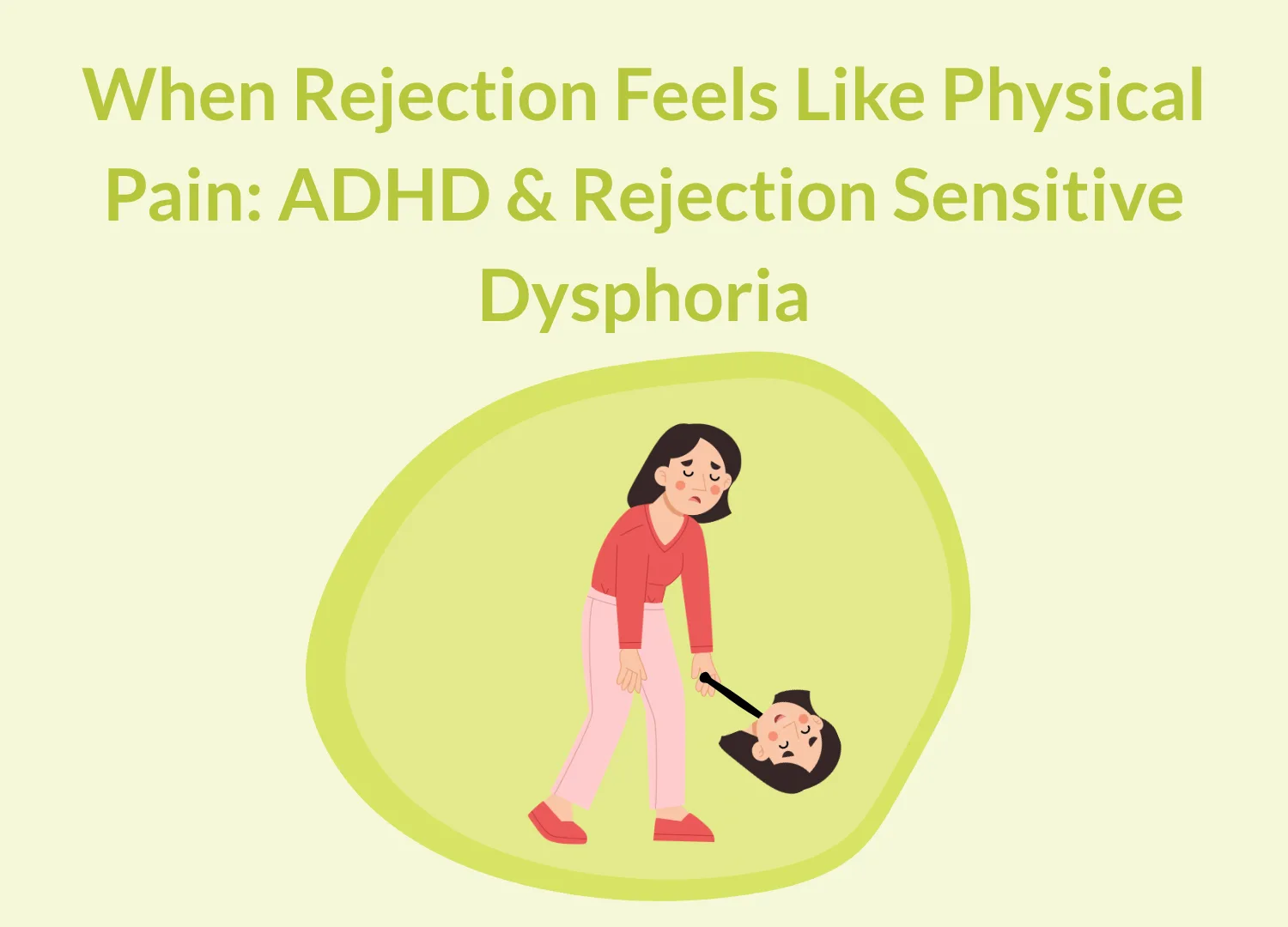
To neurotypicals these are minor everyday occurrences. But for an ADHD person the emotional reaction can come on very quickly and be devastating. Within seconds they can experience emotional pain or social withdrawal.
When most people think of Attention Deficit Hyperactivity Disorder (ADHD) they think of lost belongings, missed deadlines and struggling to stay seated in the classroom. Yet if you ask an ADHD person what causes daily distress, you often hear it’s the emotional rollercoaster that goes hand in hand with ADHD.
More specifically, it is about a phenomenon known as Rejection Sensitive Dysphoria (RSD). Understanding RSD can be transformative for people navigating their identity post-diagnosis. Struggles with emotion regulation can often feel shameful, so understanding the why can be helpful.*
*It is also important to note that while closely linked with ADHD, many researchers recognise Rejection Sensitive Dysphoria (RSD) as a broader emotional response often rooted in past trauma.
The Lived Experience
Ella is creative, hard-working and a friendly student who is well liked by her teachers and peers. However, when Ella leaves school at the end of the day, she is exhausted, and her parents notice she becomes quickly emotionally heightened and retreats to her room. To Ella’s parents, they wonder if this is just expected ‘teen behaviour’ or maybe that ‘it’s part of growing up’.
However, what Ella’s parents are not aware of is the hours she spent perfecting a history essay. The history teacher provides positive feedback alongside telling her she mispelt some words that required correction.
For the history teacher, they are simply providing Ella with constructive feedback on how to improve her work. But for Ella, she feels a deep sense of rejection and starts to experience negative thoughts such as ‘My teacher hates me’ and ‘My teacher must think I’m the dumbest person in the room.’ For Ella, she experiences an intense emotional reaction that she works very hard to suppress in the classroom so her peers and teachers may not even notice she is struggling in the moment.
Ella goes home and releases all her suppressed emotions from the school day. Except Ella’s parents are misinterpreting RSD as ‘a typical teen emotional outburst’. This leaves Ella feeling more misunderstood, and so the feelings of shame become even bigger.
**This is a made-up scenario for the purpose of understanding RSD.
So what is RSD and why isn’t it in the DSM-5?
If you do a quick online search for the term ‘RSD’, it reveals many personal accounts detailing people’s lived experiences. Yet the Diagnostic and Statistical Manual of Mental Disorders (DSM-5) and the International Classification of Diseases (ICD-11), the standard medical manuals used by clinicians to diagnose mental health conditions, do not currently include RSD as part of the picture when exploring whether someone may be ADHD.
Why might this be the case?
That past trauma and scar tissue can cause the ADHD brain to become a hypervigilant threat detector. It is constantly scanning the environment for any sign of disapproval, like an unanswered text message or a slight change in someone’s tone of voice. When the brain detects a potential threat of rejection, it can trigger a massive fight-or-flight response.
The Hidden Cost of Unrecognised RSD
Masking – Some individuals cope by attempting to become “flawless”. To hide the intense anxiety that rejection sensitivity triggers, ADHD people have reported heavily masking or camouflaging their true feelings. This masking often leads to feeling disconnected from their true selves, which can increase their sense of loneliness.
The Protective Wall – The expectation of rejection is often so terrifying that it causes more distress than the rejection itself. To protect themselves, ADHD people can often preemptively withdraw from friendships and clubs and engaging in their hobbies.
Diagnostic Overshadowing – Because RSD causes sudden emotional shifts, teenagers and adults with unrecognised ADHD are frequently misdiagnosed with Borderline Personality Disorder (BPD), Bipolar Disorder and Social Anxiety.
Physical Impact – Rejection sensitivity is not just “in your head” it can be felt physically. ADHD people have described it as a painful and overwhelming physical experience that can last anywhere from hours to weeks and can even resurface years later.
Supporting someone experiencing RSD
Understanding RSD offers a roadmap for building emotional resilience and communication strategies that work with the neurodivergent brain.
For ADHD individuals:
Name It: When that sudden wave of shame hits, pause and label it: “This is my RSD speaking right now.”
The S.T.O.P.P. technique serves as a framework to pause when facing emotional overwhelm:
S – Stop: Pause immediately when you notice stress or a trigger.
T – Take a breath: Inhale through your nose and exhale slowly through your mouth.
O – Observe: Pay attention to your thoughts, physical sensations and urges.
P – Pull back: Zoom out; sometimes our brain can make things seem worse than they are.
P – Practice what works: Choose a helpful, value-aligned action to move forward.
For Parents and Partners:
Separate Feedback from Affection: When delivering constructive feedback to an ADHD child, explicitly separate their actions from your love for them.
Instead of – “Why haven’t you done the dishes yet?”
Try – “I love you, and I need your help with the dishes. Let’s get them done together before we relax.”
Reframing how you speak: Phrases like “We need to talk later” or “Can I see you in my office?” can trigger immediate intense panic in someone with RSD. Always provide context immediately (e.g., “Can we chat later about summer holiday plans?”).
Moving Forward with Compassion
Rejection Sensitive Dysphoria can make the world feel like a harsh, unpredictable place for someone who is ADHD. However, simply having a name for this experience is often the first step toward normalising ADHD experiences.
When parents, teachers and adults realise that extreme reactions aren’t intentional “drama” but a real response to emotional pain, the conversation shifts from blame to support.
Take the Next Step
Related Posts

A stitch in time or a lifetime of scars? The urgent case for early autism assessment
Exploring the need for early child autism assessments to prevent a lifetime of...
You Are Not Alone: A Parent’s Guide to Finding Support
Support your neurodivergent teen. This guide provides a directory of...
Why are waiting lists for Autism assessments so long?
There is increasing evidence that waiting times for Autism assessments in the UK...
Free Psycho-Education Sessions For Parents/Carers with Autistic children and young people
We're developing free-of-charge parent/carer sessions for families with autistic...