
A typical CAT-Q score for non-autistic individuals is usually below 100, though the average range is between 90-109. For autistic individuals, the average score tends to range from 109 to over 125 out of a maximum of 175.
Free CAT-Q Camouflaging Test
The Camouflaging Autistic Traits Questionnaire (CAT-Q) is a self-report measure of social camouflaging, or masking behaviours designed for people aged 16 and upwards. It is used to identify individuals who, due to their ability to mask their autistic traits, may not receive a diagnosis of autism when, in fact, they are autistic.
Our Clinical Director, Dr Judy Eaton, explains why so many people are not correctly diagnosed as being autistic in her blog.
What Is the CAT-Q Test?
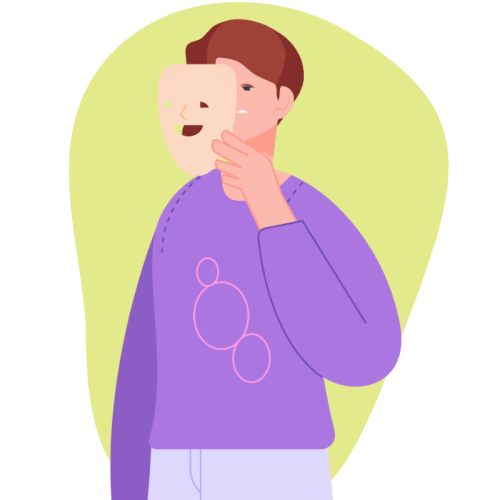
The CAT-Q measures the degree to which you use camouflaging or masking strategies. The more you camouflage, the more of your authentic autistic presentation you are likely able to suppress. This can lead clinicians carrying out an autism assessment, whether you are an adult or child, to not see your authentic self and, in turn, state you do not meet the criteria for an autism diagnosis. There is some evidence to suggest that autistic girls and women are more likely to mask, but it is not only girls who mask.
The CAT-Q measures camouflaging in general, as well as three subcategories:
Compensation
Strategies used to actively compensate for difficulties in social situations, including:
- Copying body language
- Copying facial expressions
- Learning social cues from films, books, etc.
- Repeating phrases used by neurotypical individuals
Masking
Strategies used to hide autistic characteristics or portray a non-autistic persona, including:
- Adjusting face and body to appear confident and/or relaxed
- Forcing eye contact
- Constantly being aware of the impression ‘I’m having on people’
Assimilation
Strategies used to try to fit in with others in social situations, including:
- Putting on an act
- Avoiding or forcing interactions with others
- Constantly trying to pretend to be ‘normal’
How the CAT-Q Works
The CAT-Q consists of 25 statements, giving you 7 choices for each statement:
- Strongly Disagree
- Disagree
- Somewhat Disagree
- Neither Agree Nor Disagree
- Somewhat Agree
- Agree
- Strongly Agree
The 25 statements relate to 3 subcategories of camouflaging:
- 9 statements (compensation)
- 8 statements (masking)
- 8 statements (assimilation)
Frequently Asked Questions
A high CAT-Q score is generally considered to be 113 and above. If you score over 100 in the CAT-Q, further exploration of possible autism could be helpful. If you score over 125, this indicates a very high level of masking, and it is worth considering booking an assessment.
You can use our FREE children’s screening tool for young people between the ages of 4-18, or our adult screening to see whether you show signs of possible autism and whether it’s worth having a further assessment.
The CAT-Q is very accurate at measuring how much a person masks autistic traits, as long as the individual answers the questions honestly. However, it is not a diagnostic tool for autism because some neurotypical people can score highly, as well as those with ADHD or social anxiety.
Autistic ‘masking’ has become an increasingly discussed topic. It is something that autistic individuals (particularly girls and women) do to hide or ‘camouflage’ their autistic traits in order to fit in with social norms and expectations and reduce the risk of being perceived as ‘different’ or ‘odd’. It is believed to start relatively early in life, most notably around the time that children start primary school.
If you have been masking autistic traits for most of your life, it can sometimes be difficult to tell when you’re doing it. That’s why the CAT-Q can be a useful way of identifying masking behaviours, as it asks you to think about how you react in social situations.
Typical signs of masking include:
- Consciously forcing eye contact
- Mirroring other people’s facial expressions
- Holding back urges to fidget or engage in self-soothing behaviours (often called ‘stimming’)
- Rehearsing what you want to say in advance of social situations
No, the free CAT-Q test is exactly that… FREE. It provides instant feedback based on your answers, but it is entirely your choice whether to pursue your results with us.
No, the test is not a diagnostic tool. It should be used only to determine whether you or your child shows signs of possible camouflaging of autism. We can only provide a diagnosis after a face-to-face or online meeting to conduct a formal assessment. If you wish to proceed, please contact our team for further information.
No, we don’t share the details with any third parties. Please see our privacy policy to find out more about how we process your information.
Rights & permissions
This test is distributed under the terms of the Creative Commons Attribution 4.0 International License, which permits unrestricted use, distribution, and reproduction in any medium, provided you give appropriate credit to the original author(s) and the source, provide a link to the Creative Commons license, and indicate if changes were made.
Development and Validation of the Camouflaging Autistic Traits Questionnaire (CAT-Q)
Rights & permissions
This test is distributed under the terms of the Creative Commons Attribution 4.0 International License, which permits unrestricted use, distribution, and reproduction in any medium, provided you give appropriate credit to the original author(s) and the source, provide a link to the Creative Commons license, and indicate if changes were made.
Development and Validation of the Camouflaging Autistic Traits Questionnaire (CAT-Q)